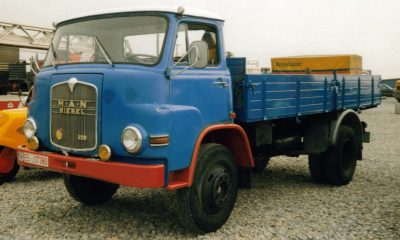
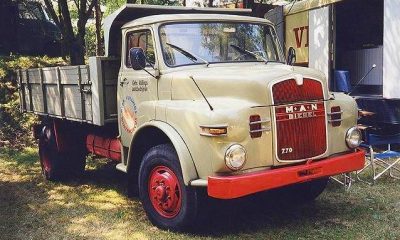
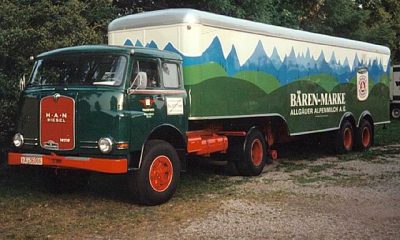
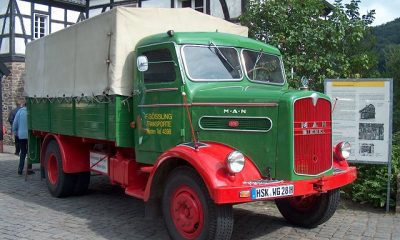
Germany:
1915 -
p.t.MAN company historians trace the firm's roots to the early 19th century, when Napoleon, during his campaigns, is said to have proposed building a railway in Bavaria. Responding to the idea, the wealthy Nuremberg merchant Johann Friedrich Klett decided to subsidise the first 5 km (3.1 miles) of the line and in 1841 founded a company under his name, producing equipment for building and operating the new railway. In 1871 it passed to his son-in-law Theodor Cramer-Klett and was renamed Maschinenbau AG Nürnberg.
The second predecessor of today's MAN is the machine-building firm of Ludwig Sander, founded in Augsburg in 1840 and producing steam engines. From 1858 the two firms cooperated, and exactly 40 years later they merged into the Vereinigte Maschinenfabrik Augsburg und Maschinenbaugesellschaft Nürnberg AG. The group was shortened to Maschinenfabrik Augsburg-Nürnberg AG, which gave the well-known abbreviation MAN.
From 1904 MAN built steam boilers, turbines, bridge trusses, hydraulic pumps, trams and railway wagons. A great influence on the company came from the engineer Rudolf Diesel (1858–1913), who worked for several years at the Augsburg firm. On 23 February 1893 he received a patent for a four-stroke internal combustion engine that opened the era of diesel engines.
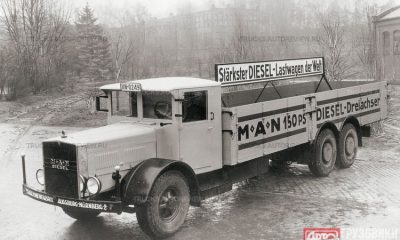
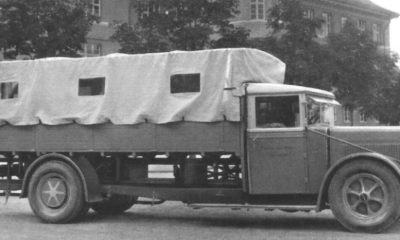
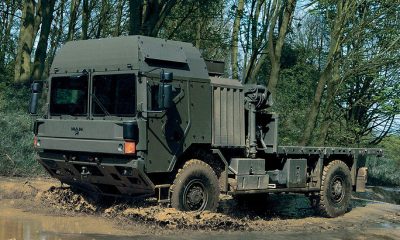
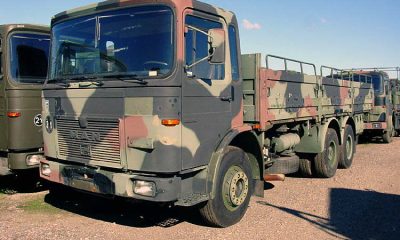
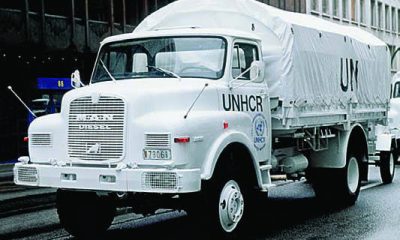
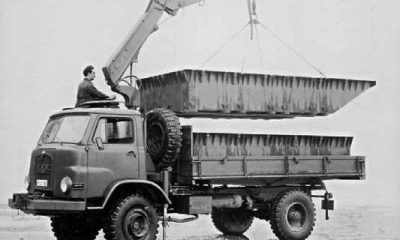
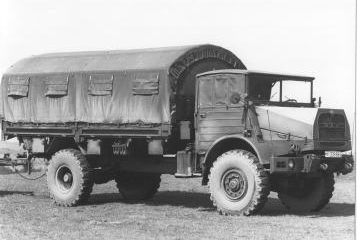
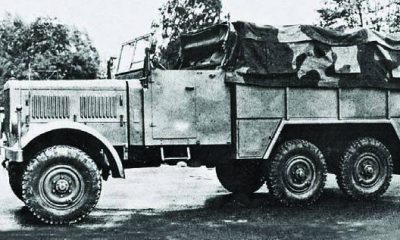
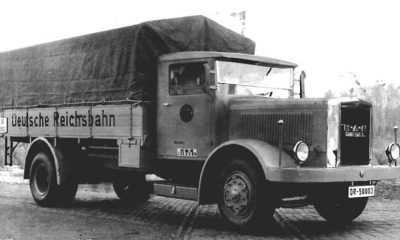
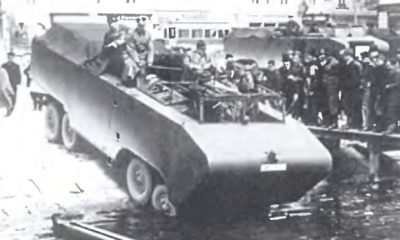
In 1915 production of 5-tonne (11,023 lb) MAN-Saurer trucks with a four-cylinder 45 hp (33 kW) petrol engine began in Lindau. The firm's later success in the automotive field rested on the constant improvement of its diesel engines. In 1927 a new 200 m (656 ft) long workshop for truck and bus assembly was opened in Nuremberg, allowing up to 3,000 vehicles a year, and a new family of diesel engines appeared with one or two exhaust valves and a vertical Robert Bosch injector. In 1931 MAN announced the most powerful diesel truck in the world, the three-axle S1H6 with a six-cylinder engine of 150 hp (110 kW). Between 1933 and 1938 annual vehicle output rose from 323 to 2,568, 25% of them exported. From 1935 MAN began active development of army trucks, including 6×6 versions.
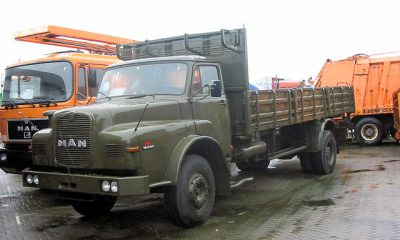
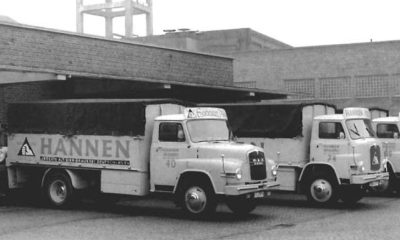
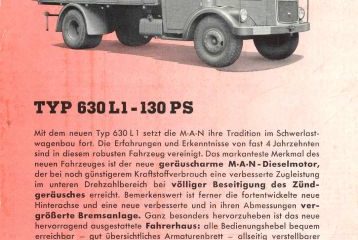
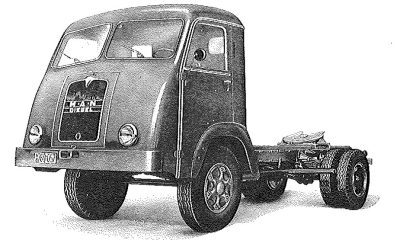
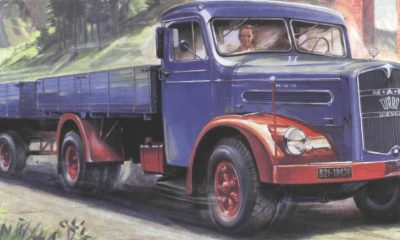
In 1944–45 the Nuremberg plant was heavily damaged, and from 8 May 1945 it repaired American trucks. Only in the autumn did it return to assembling the pre-war L4500 series. In the early 1950s MAN resumed forward-looking development, and in 1951 the first German turbocharged diesel engine appeared, developed by Professor Siegfried Meurer. It proved so attractive that in the 1950s and 60s many firms in Europe, Asia, America and Australia bought licences for it. A new truck family and a new model designation system were created in the early 1950s, where the numbers encoded payload and rounded power.
By the mid-1950s demand for MAN trucks was so high that Nuremberg could no longer cope. In April 1955 the company bought the former BMW aircraft engine plant in Munich, which was expanded and became the main plant. In 1962, when its staff grew from 2,270 to 10,000, about 10,000 trucks were built there. After another reorganisation and the opening of a new 300 m (984 ft) assembly hall, output rose to 12,400 chassis a year. The old Nuremberg plant continued to make engines, axles and castings.
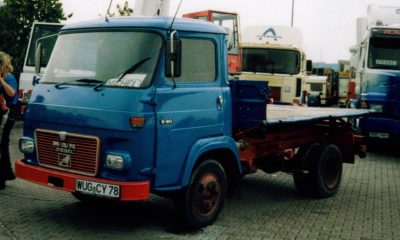
In 1963 cooperation with Saviem began, which three years later granted MAN the right to build its vehicles of 1.5–3.5 tonnes (3,307–7,716 lb) payload, sold as MAN-Saviem. By 1967 the MAN range had grown to 22 models (from "5.126" to "22.215"), with a changed designation: the first number indicated the rounded gross weight, the number after the point the engine power. The Hungarian company Raba and the Brasov truck plant in Romania bought licences for MAN vehicles and engines at that time. Assembly plants started work in Turkey, Portugal, Yugoslavia, South Africa, India and South Korea. There was also less visible cooperation with Daimler-Benz on engines, air suspension and planetary hub reductions.
In 1968 MAN bought 25% of Büssing, one of the largest German truck makers, and absorbed it fully in 1971, so the roaring Büssing lion appeared on the grille under the MAN name. The takeover of the Austrian firm ÖAF in 1970 made it possible to set up in Vienna a division for special multi-axle chassis, heavy dump trucks and fire engines with engines of up to 760 hp (559 kW). In the mid-1970s MAN gave up V-engines to concentrate on six-cylinder units and began to use modular design. In 1978 total MAN vehicle production was 21,337. In 1979 MAN began cooperation with Volkswagen on medium-duty trucks, sold as MAN-VW. A few years later Volkswagen ended the cooperation, and the jointly developed product became the basis of the new L2000 generation.
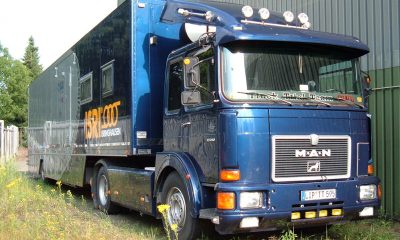
In 1985 the truck division of MAN AG was made an independent company, MAN Nutzfahrzeuge AG, employing more than 20,000 people in Germany alone. In 1990 MAN fully bought the Austrian firm Steyr, and total output exceeded 30,000 for the first time. In 2000 MAN acquired the British company ERF and the Polish plant Star; its plants now employ about 32,000 people. In 1999 another record was set: MAN plants built 56,300 vehicles of more than 6 tonnes (13,228 lb) gross weight, 3.5% of world production. At the beginning of 2000 the one-millionth MAN truck was built.
Read more